



how can we assist you with electrification?
I want to learn about electrification and its benefits
Tell me more about what electrification is
Electrification is the process of transitioning away from fossil fuels (natural gas, propane, oil, coal, gasoline, etc.) to clean, renewable electricity like solar and wind. Electrification can refer to both buildings and vehicles. Building electrification, or building decarbonization, specifically refers to replacing appliances that traditionally run on natural gas with all-electric alternatives. Electrifying commercial and multi-family buildings is one of the most impactful steps toward reducing GHG emissions, improving indoor air quality, and lowering long-term operating costs. Unlike single-family homes, these buildings often have centralized systems, higher energy loads, and complex ownership structures, which means planning is essential.
Electrification of commercial and large multi-family building systems is often more complicated than the more uniform and simple systems found in single family buildings. However, proven technologies and electrification measures exist today to make the transition smooth and cost-effective. From heat pump systems for space and water heating to induction cooking, EV charging, and on-site solar with battery storage, electrification can deliver healthier, safer, and more resilient buildings. Some commercial buildings like small offices might share similar appliances to single family homes (like a small water heater), but many commercial systems will need to consult with an engineer or commercial contractor to identify the most cost-effective electrification strategies. A summarized list of electrification strategies and all-electric alternatives are summarized below:
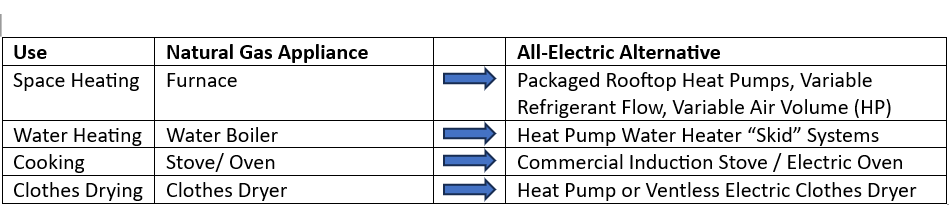
In addition to these equipment replacements, there are other measures you can take to support the electrification of your building. These measures include:
- Electrifying outdoor pool pumps and grills
- Installing electric vehicle charging infrastructure
- Installing solar PV and battery storage systems
- Completing energy efficiency/building envelope retrofits (e.g., insulation, air sealing, windows/doors, smart controls, air circulation fans, LED lighting etc. )
Tell me why electrification matters

Fossil fuels release greenhouse gas (GHG) emissions when burned, which exacerbates climate change and leads to worsening climate-driven disasters including wildfires, extreme heat, and poor air quality. According to Pinole’s most recent comprehensive GHG inventory in 2017 as discussed in the City’s Climate Action and Adaptation Plan (CAAP), 37% of Pinole’s GHG emissions come from natural gas use in residential and nonresidential buildings. Therefore, building electrification is a crucial strategy for reducing GHG emissions and fighting climate change. Additionally, Pinole’s building stock is primarily made up of single-family residential buildings, many of which were built before 1990 (City of Pinole, General Plan Land Use and Economic Development Element). Thus, single-family residential electrification offers the most significant opportunity to electrify Pinole’s building stock and reduce emissions in line with the CAAP.
While some electricity is still produced with fossil fuels, utility providers across the Country are increasingly investing in renewable energy, greening the electric grid over time. Pinole receives energy from Marin Clean Energy (MCE), delivered via PG&E infrastructure. MCE is a local community choice aggregator providing renewable electricity options for up to 100% renewable electricity (MCE’s Deep Green Program).
Consistency with the City’s Goals
Pinole’s CAAP intends to achieve building electrification and energy resilience goals via the following Measures, of which the Electrification Concierge Program is a supporting action:
- BE-1: Electrify 100% of new construction in the City in 2024
- BE-2 Electrify existing residential buildings to reduce natural gas consumption by 26% by 2030 and 100% by 2045
- BE-3 Electrify existing commercial and mixed-use (i.e., combined commercial and residential) buildings to reduce natural gas consumption 18% by 2030 and 100% by 2045
- BE-4 Increase the number of accounts enrolled in MCE’s Deep Green option to 95% communitywide by 2030
- BE-5 Increase generation and storage of local community-scale renewable energy
Tell me about additional benefits of electrification

Making this transition not only allows buildings to use increasingly cleaner energy sources, but also provides the following co-benefits:
Health: Removing gas appliances improves indoor air quality.
Several studies have linked gas stoves to increased asthma rates due to pollutants produced by these appliances. Children living in homes with gas stoves have a 24% increased risk of being diagnosed with asthma and 42% increased risk of experiencing asthma symptoms including wheezing.
Cost Control: Heat pumps and efficient electric systems lower energy bills over time, especially when paired with load management and renewable energy.
Not only are electric appliances more efficient than gas, resulting in less utility use, but gas rates are rising faster than electricity rates, which will continue to make gas more expensive in California. Electrifying your building as appliance reach end of life is a smart way to lower your long-term operation costs and available incentives can help reduce upfront installation costs.
Futureproofing: Building codes and tenant expectations are moving toward all-electric. Early adoption avoids costly retrofits later.
In March 2023, the Bay Area Air District approved a Zero-NOx Requirement for newly installed furnaces and water heaters in the Bay Area. Currently, only electric appliances comply with these standards. All commercial furnaces and water heaters will need to comply by January 2029 and 2031, respectively.
Climate Leadership: Commercial and multifamily buildings account for a significant share of urban emissions. Electrification eliminates on-site combustion and leverages increasingly clean electricity.
Fossil fuels release greenhouse gas (GHG) emissions when burned, which exacerbates climate change and leads to worsening climate-driven disasters including wildfires. According to Pinole’s most recent comprehensive GHG inventory in 2017 as discussed in the City’s Climate Action and Adaptation Plan (CAAP), 37% of Pinole’s GHG emissions come from natural gas use in buildings. Therefore, building electrification is a crucial strategy for reducing GHG emissions and fighting climate change.
While some electricity is still produced with fossil fuels, utility providers across the country are increasingly investing in renewable energy, greening the electric grid over time. Pinole receives energy from Marin Clean Energy (MCE), delivered via PG&E infrastructure. MCE is a local community choice aggregator providing renewable electricity options for up to 100% renewable electricity (MCE’s Deep Green Program).
Pinole’s CAAP intends to achieve building electrification and energy resilience goals via the following Measures, of which the upcoming Electrification Concierge Program is a supporting action:
BE-1: Electrify 100% of new construction in the City in 2024.
BE-2 Electrify existing residential buildings to reduce natural gas consumption by 26% by 2030 and 100% by 2045.
BE-3 Electrify existing commercial and mixed-use (i.e., combined commercial and residential) buildings to reduce natural gas consumption 18% by 2030 and 100% by 2045.
BE-4 Increase the number of accounts enrolled in MCE’s Deep Green option to 95% communitywide by 2030.
BE-5 Increase generation and storage of local community-scale renewable energy.
Show me what electrification looks like
Header text
I need help selecting the right electrification project for my building
I want to learn more about different electrification projects first
Space Heating and Cooling- Heat Pump Heating and Air Conditioning
Equipment Alternatives & Definitions:
- Packaged Rooftop Heat Pumps (RTUs): All-in-one units that replace gas RTUs; ideal for small to mid-sized commercial buildings.
- Variable Refrigerant Flow (VRF) Systems: Multi-zone systems using refrigerant piping for heating and cooling; compact and flexible for offices and multi-family units.
- Air-to-Water Heat Pumps: Centralized systems producing hot/chilled water for hydronic distribution; common in large buildings.
- Water Source Heat Pumps: Use water loops or geothermal sources for heating/cooling; often paired with heat recovery.
- Variable Air Volume (VAV): in a VAV system, a gas boiler is used to heat a water loop, which then heats or cools air to its desired temperature. Electrification of these systems involves using an air to water heat pump instead of the gas boiler.
Benefits:
- 2–4x more efficient than gas boilers/furnaces
- Provides both heating and cooling in one system
- Eliminates on-site combustion emissions and improves indoor air quality
Key Considerations:
- Electrical service upgrades or load management
- Refrigerant leakage risk (VRF); consider low-GWP refrigerants
- Space for outdoor units and airflow
- Integration with existing ductwork or piping
Water Heating
Equipment Alternatives & Definitions:
- Central Heat Pump Water Heaters (CHPWH): Large systems serving entire buildings; often skid-mounted for plug-and-play installation which can be located on the roof or outdoors.
- Distributed HPWH Units: Smaller units for decentralized or point-of-use applications.
Benefits:
- 3–4x more efficient than gas boilers
- Enable load shifting with thermal storage
- Reduce GHG emissions significantly
Key Considerations:
- Space for tanks and heat pumps which are larger than gas boilers and may not fit in the existing mechanical room (addressed with the “skid” prefabricated option).
- Commercial mechanical rooms will most likely require an electrical panel upgrade.
- HPWHs require sufficient ventilation, but locating the heat pump on the roof could require additional structural support
- Electrical load and backup resistance heating.
- Must use strategies to prevent growth and spread of Legionella bacteria. Notably by keeping temperatures above 140 °F and avoiding stagnant water.
- Combining versus separating domestic hot water heating from water used in space heating. While both water heating systems can be combined, domestic water requires higher standards and different temperatures which could increase costs.
- Utilize Ecotope’s Ecosizer to size your project’s heat pump water heater system rather than sizing the heat pump to the same recovery rate and capacity as a boiler.
Cooking
Equipment Alternatives & Definitions:
- Induction Cooktops & Woks: Use magnetic fields to heat cookware directly; highly efficient and precise
- Electric Convection & Combination Ovens: Provide baking, roasting, and steaming without combustion
- Electric Fryers, Griddles, and Warmers: High-efficiency replacements for gas fryers and grills
Benefits:
- Faster, more precise cooking (induction boils water twice as fast as gas)
- Improved indoor air quality (no NO₂ or CO)
- Cooler kitchens, reducing HVAC loads
- Commercial all-electric kitchen equipment is more narrow than traditional gas alternatives, maximizing kitchen space
Key Considerations:
- Requires magnetic cookware for induction
- Electrical upgrades for high-load appliances
- Staff training for new equipment
Clothes Drying
Equipment Alternatives & Definitions:
- Heat Pump Dryers (vented or ventless): Use a refrigeration cycle to dry clothes at lower temperatures
Benefits:
- Up to 50% less energy than resistance or gas dryers
- Lower operating costs and gentler on fabrics
- Ventless options simplify retrofits
Key Considerations:
- Longer drying cycles
- Condensate management for ventless models
- 240V electrical requirements
Pools & Spas
Equipment Alternatives & Definitions:
- Heat Pump Pool Heaters: Air-source or water-source units that heat large volumes of water efficiently
Benefits:
- 50–70% less energy than gas pool heaters
- Lower operating costs and maintenance
- No combustion emissions
Key Considerations:
- Electrical load planning
- Outdoor space and airflow
- Seasonal performance in cold climates
EV Charging
Equipment Alternatives & Definitions:
- Level 2 Chargers (240V): For tenants, employees, or fleets
- DC Fast Chargers: For fleets that need fast turn-around or public access
Benefits:
- Supports EV adoption and sustainability goals
- Potential revenue stream for commercial properties
- Reduces transportation emissions
Key Considerations:
- Electrical service upgrades or load management
- ADA compliance and parking layout
- Smart charging for demand control
Solar PV & Battery Storage
Equipment Alternatives & Definitions:
- Rooftop Solar PV: Generates renewable electricity on-site
- Battery Energy Storage Systems (BESS): Stores energy for peak shaving and backup power
Benefits:
- Reduces energy bills and demand charges
- Provides backup power during outages
- Supports electrification by offsetting new loads
Key Considerations:
Battery siting and ventilationgy-efficient supplies such as LED lights, a smart power strip and more. (supplies offered are subject to change)
Roof structural capacity and shading
Fire code and interconnection requirements
Load Management & Electrical Panel Upgrades
Equipment & Definitions:
- Load Management Tools: Smart panels, circuit-sharing devices, and scheduling controls
- “Watt Diet” (freeing up capacity by replacing inefficient equipment, using smart controls, and sequencing loads) measures:
- Replace old lighting with LEDs
- Use lower-wattage heat pump water heaters with larger storage tanks
- Implement demand control for HVAC and EV charging
Benefits:
- Cost Savings: Avoid or defer expensive panel upgrades by reducing peak demand
- Faster Electrification: Smart load management can accelerate project timelines
- Futureproofing: Prepares your building for additional loads like EV charging and battery storage
- Grid-Friendly: Shifts loads to off-peak hours, reducing strain on the grid
Key Considerations:
- Panel Assessment: Check main breaker rating (e.g., 100A, 200A) and available breaker slots
- When to Upgrade: If service is undersized or fully utilized, plan for a panel upgrade (often 200A+ for small commercial/multifamily)
- Incentives: Federal and state rebates can offset upgrade costs
Energy Efficiency Retrofits
Equipment & Definitions:
- Air Sealing: Seal gaps in walls, roofs, and around windows/doors
- Insulation: increase insulation to retain hot and cool air and put less stress on space heating and cooling appliances
- Windows: Upgrade to double or triple glazing
- Lighting: Replace fluorescent/incandescent with LEDs
- Controls: Add daylighting sensors, occupancy sensors, and advanced thermostats
Benefits:
- Lower Energy Demand: Reduces HVAC size and operating costs and helps avoid costly panel upgrades
- Comfort: Eliminates drafts and stabilizes indoor temperatures
- Health: Improves indoor air quality when paired with proper ventilation
- Immediate ROI: Lighting and controls often pay back in 1–3 years
Key Considerations:
- Historic Buildings: May require creative solutions for insulation and window upgrades
- Moisture Management: Ensure proper vapor barriers when adding insulation
Learn more about different all-electric equipment options
I would like to find contractors for project bids
BROWSE THE DIRECTORY HERE! Pinole All-Electric Building Concierge Contractor Directory VBA.xlsm
What Information Does the Directory Include?
- Company Name and Contact Information
- Contractor License Type and Number
- Types of Electrification Projects Offered (e.g., Heat Pump HVAC, Water Heater, Solar/Battery)
- Financing Options Available
- Rebate Program Support
- Languages Spoken
- Service Area
I want to learn about cost, incentives and financing for electrification projects
Transitioning multifamily and commercial buildings away from fossil fuels and toward clean electric technologies offers significant benefits including healthier indoor environments, improved resilience, and the potential for long-term savings. Electric appliances can replace gas-powered systems with efficient electric alternatives for space heating, water heating, cooking, clothes drying, and building owners may even integrate solar and battery storage solutions.
While electrification often involves higher upfront investment, it typically leads to lower operating costs over time. This trend is driven by rising natural gas prices and the high efficiency of heat pumps (up to 400%). This pattern of rising natural gas rates is expected to continue and outpace electric rate increases according to a 2021 Gridworks study.
Multifamily and commercial properties present unique opportunities to enhance building value and tenant comfort. However, these projects can be more complex than single family retrofits due to the high variability and more complex nature of the technologies deployed in commercial and multifamily buildings. There is no universal approach, but following best practices can help set your property on a successful path toward electrification. Smaller multi-family buildings (2-4 units) or small commercial buildings tend to utilize similar appliances as those in single family homes. Approximate costs and available rebates for these building types can be found on our single family electrification cost page. However, for commercial and large multifamily buildings, equipment types and required installation labor vary widely, leading to less standardized cost estimates. The following cost estimates are informed by limited available space heating and water heating cost data for multifamily buildings through TECH Clean California
See Contra Costa County’s Clean Energy Roadmap to learn more about why to electrify and how to mitigate any financial burden to make the switch!
Electrification project cost ranges
Space Heating
Multifamily buildings can often leverage ductless mini-split technologies which can scale up to as many units/zones as needed. New heat pump form factors are also being developed through programs in California and New York to meet the needs of multifamily buildings including wall mounted and window mounted heat pumps which are low cost (~$5,000 per unit).
Most commercial buildings in the Bay Area use rooftop packaged units which utilize natural gas for heat and a heat pump for cooling, packaged together in one rooftop unit. Switching to a packaged unit which only uses a heat pump can often be done for little to no cost increase. What’s more, under the new 2025 building code, heat pump packaged units will be the baseline case for replacements for units up to 10 tons. Costs will depend on the tonnage of the building and the heating and cooling properties, but a case study by the Los Angeles Unified School District found that upgrading to heat pump rooftop packaged units provided a 12% lifecycle savings compared to gas systems.
Water Heating
Water heating electrification projects involve the transition of natural gas fired water heaters to heat pump water Some commercial buildings and many smaller multifamily properties share similar appliances to single family homes (like a small water heater), in which case cost data would be similar to that of single family homes and can be found on our single family electrification cost page. In contrast, large commercial systems utilizing boilers or water heaters with a capacity above ~100 gallons will need to consult with an engineer or commercial contractor to identify the most cost-effective electrification strategies.
Cooking and Clothes Drying
Multifamily and most commercial properties with cooking or clothes drying utilize the same appliances as used in single family homes. Costs for these appliances for induction stoves/ electric ovens and electric clothes dryers can be found on the single family electrification cost page. For multifamily buildings, it is typically much more cost effective to install 120 V cooking ranges to avoid costly circuit upgrades that are required for most standard induction cooking ranges.
Restaurants can also make the transition to electric appliances. A whole range of electric commercial equipment is currently available, and California has a suite of incentives to support the transition to higher efficiency appliances. You can check out rebates and available equipment here!
Financing
Financing plays a pivotal role in accelerating building electrification by lowering upfront costs and enabling property owners to unlock long-term energy savings and climate benefits. For commercial and multifamily buildings, financing options help overcome the barrier of high initial investment for upgrades such as heat pumps, electric water heaters, EV charging stations, and building envelope improvements. By offering flexible repayment structures, these programs broaden accessibility for businesses and housing providers to upgrade their buildings, provide better services to tenants and reduce environmental impacts. Below are the benefits and drawbacks of financing, followed by definitions of common financing terms.
Benefits of Financing
- Reduces Upfront Costs: Makes major upgrades like heat pumps, solar, and EV infrastructure more affordable immediately.
- Improves Accessibility: Enables small businesses and multifamily property owners to participate in electrification without large upfront capital investment.
- Aligns Payments with Savings: Monthly payments can be offset by reduced energy bills and operational costs.
- Supports Comprehensive Upgrades: Allows bundling of multiple improvements (e.g., HVAC electrification + insulation + EV chargers).
- Flexible Options: Programs like PACE or on-bill repayment offer long terms and alternative qualification criteria.
- Enhances Asset Value: Energy-efficient and electrified buildings often command higher market value and tenant appeal.
Cons of Financing
- Interest or Fees: Loans increase overall costs over time, even if rates are low. Zero percent loans (available through some programs) negate this downside.
- Debt Obligation: Creates a long-term financial commitment that may affect credit or borrowing capacity.
- Eligibility Barriers: Credit checks or ownership requirements can exclude certain businesses or property types.
- Lien Impact: PACE financing attaches to property taxes, which can complicate refinancing or selling.
- Complexity: Navigating multiple programs and terms can be challenging for property managers.
Financing Terms Defined:
- On-Bill Financing (OBF): Utility or partner lender provides upfront funds for energy upgrades. Repayment is added to your monthly utility bill, often at 0% interest, and designed so energy savings offset costs.
- On-Bill Repayment (OBR): Similar to OBF, but the loan is funded by a third-party lender while the utility collects payments through your bill.
- Zero Percent Financing: A traditional loan with no interest charged; you repay only the principal amount. Payments go directly to the lender, not through your utility bill.
- Green Loan: A loan specifically for sustainability improvements (e.g., solar panels, EV chargers). Offered by banks or credit unions with terms focused on environmental benefits.
- Property Assessed Clean Energy (PACE) Financing: Provides upfront financing for energy, water, and resilience projects. Repayment occurs via a special assessment on your property tax bill over 5 to 30 years. The obligation stays with the property if sold.
Reliable financing options for your electrification home improvements include:
PG&E’s On-Bill Financing / Energy Efficiency Financing: Provides 0% interest loans on qualifying energy-efficient upgrades, repaid through utility bills. Business customers can access up to $250K–$4M across approximately 10-year terms.
Property Assessed Clean Energy (PACE) Financing: Pinole has approved three PACE providers (Ygrene, HERO, and CaliforniaFIRST) allowing business owners to finance up to 100% of energy upgrades and repay via annual property tax assessments. These long-term loans are tied to the property, not the owner’s credit, and can be passed to the next property owner in the event of sale.
California GoGreen Financing: California’s GoGreen Eco Friendly Business Loan Program helps match business owners with low-interest loans for energy-saving property improvements.
Rebates
Currently, the Pinole Energy Enhancement Rebate Program offers incentives for a suite of measures for multifamily. Because multifamily and commercial buildings can come in many different building typologies, there is also not a one size fits all rebate. Smaller multifamily buildings (2-4 units) can apply for many of the same rebates as single family properties due to similar appliances. The most reliable general funding pathways include state and regional programs such as TECH Clean California, which offers incentives for heat pump installations and contractor training; PG&E programs and offerings for multifamily building electrification; and BayREN programs, which supports energy efficiency upgrades for qualified multifamily properties.
These programs serve as critical tools to offset upfront costs and make electrification more accessible and affordable for multifamily and commercial businesses across the region. However, the availability of these rebates changes quickly, especially in the current political landscape. There is no comprehensive up to date list of all multifamily and commercial electrification rebates; however, various resources are available to find rebates, including:
- The Switch is On shows multifamily rebates, financing, and other cost-saving opportunities specific to your zip code and electrification project of interest.
- PG&E’s Business Energy Efficiency Rebates and Incentives shows rebates by product and by industry from PG&E third-party programs.
- Energy Star’s Energy Efficiency Rebates for Commercial Buildings shows rebates from top utilities across the country for key electrification upgrades.
If you are thinking about electrification, Marin Clean Energy (MCE) offers free technical assistance to help make the electrification journey easy, efficient, and cost-effective. MCE’s program offers the following benefits and is eligible to all multifamily property customers within MCE’s service area.
- A site walk-through with a dedicated energy coach and engineering staff to identify energy savings opportunities
- Up to 15% energy savings with little to no capital investment
- Incentives for energy saved
- Up to $6,000 in additional incentives for achieving program milestones
- MCE-AIR-Program_2025-Deemed-Rebate-List-1.pdf
Bay Area Multifamily Building Enhancements (BAMBE) also provides free technical assistance and generous rebates to make improvements simple and cost-effective for both multifamily and commercial properties.
For multifamily buildings, BAMBE provides no‑cost technical assistance and per‑unit rebates to help implement efficiency and electrification measures such as heating and cooling, water heating, lighting, weatherization, and in‑unit appliance upgrades. BAMBE has paused new enrollments for applicants who have not yet reserved rebate funds (effective July 3, 2025); however, enrollment updates and resources can be found on BAMBE’s Multifamily Program webpage.
On the commercial side, the BayREN Business program supports small and medium‑sized businesses with free equipment evaluations, start‑to‑finish project assistance, and incentives for measures like LED lighting, HVAC, refrigeration, water heating, and envelope improvements. These improvements are aimed at lowering operating costs and improving indoor comfort. Businesses can submit a quick interest form, get a no‑cost assessment, and receive help through installation to realize energy savings.
Importance of a Retro-commissioning Study
For larger systems, consulting with engineers or specialized contractors in a process called retro-commissioning (RCx) is often necessary to identify the most efficient and cost-effective electrification strategies. RCx is the process of systematically inspecting and optimizing an existing building’s systems and equipment to ensure they operate efficiently and effectively according to the current operational needs. RCx is essential to the electrification process in order to:
- Identify the working condition of current appliances to better inform end of life or future maintenance costs.
- Identify low-cost/no-cost measures (e.g., control sequences, sensor calibration, scheduling) that can cut energy use 5–15% before major retrofits.
- Help uncover hidden issues like simultaneous heating/cooling or oversized equipment.
- Identify which appliances can be downsized or deferred, making heat pump sizing and electrical planning more accurate.
I want to learn about if going electric is cost-effective
- California Energy Codes and Standards provide cost-effectiveness studies for all building types.
Tell me about upcoming programs to further simplify the switch
- Pinole Water Heater Loaner Program is under development and will help residential and potentially commercial property owners get immediately connected to a participating contractor for a temporary loaner water heater install while any necessary upgrades are made to accommodate replacement with a heat pump water heater. While programmatic features are still being developed potential offerings through the program may include no-cost permit fees and fixed pricing
- Pinole Electrification Revolving Fund is under development and will help program participants receive potentially zero or low-interest loans to cover upfront project electrification costs to be paid back into a self-sustaining fund for other prospective participants to do the same.
Tell me about how I can start planning for electrifying my building
Commercial, multi-family, and mixed-use buildings have a large opportunity to increase value and create better working and living conditions for tenants. However, they are less straight forward to decarbonize as multiple tenants, shared equipment, limited space, and other factors can complicate the electrification process. For these building types, there is no one-size-fits-all approach, but the following guidelines are the best approach to set up your business for a successful electrification journey:
Step 1: Benchmark your Current Natural Gas Appliances
Appliances can be prioritized for retrofitting based on the following factors:
- Time until replacement: It is the most economical to electrify appliances as old, natural gas appliances reach end of life. Assess when you or the previous owner installed existing appliances, appliances that need frequent repairs, and when the time to replace them will be.
- Major renovation planned: A whole building electrification approach is usually appropriate during a major renovation where large amounts of equipment are being replaced. This timing allows for heating, cooling, water heating, cooking, and other systems to be upgraded together, reducing the need for piecemeal installations later. Because walls, floors, or ceilings may already be open during construction, it is easier and more cost-effective to run new electrical wiring, upgrade panels if needed, and install modern, efficient equipment all at once. Taking this comprehensive approach can avoid multiple rounds of construction costs, minimize disruption, and ensure that new systems are designed to work seamlessly together, providing long-term energy savings and reduced greenhouse gas emissions.
- Benchmarking: Existing natural gas appliances that use the most amount of fuel should be prioritized to reduce GHG emissions and utility bills. Benchmarking your building’s current energy usage over the past 12 months using Energy Star Portfolio Manager can help you set baselines and prioritize sites and appliances to electrify first. Alternatively, to identify which appliances are driving the most use, start by reviewing your utility bill for your total gas consumption, typically measured in therms. Then, compare that number against your building appliance list and consider how often and how long each is used. For example, space heating and water heating generally account for the largest share of natural gas use in most buildings. Cross-referencing this information can help you pinpoint the appliances most responsible for high gas consumption and provide a clear starting point for efficiency improvements.
MCE’s Energy Management program is available to help Commercial, industrial, municipal, or agricultural customers with technical assistance in evaluating current equipment and making the switch.
Step 2: Conduct a Retro-commissioning Study
Due to the variability of each commercial building, there are various equipment configurations that make electrification more challenging compared to single family residential. Therefore, hiring a certified commissioning provider or energy engineer to conduct a retro-commissioning (RCx) study. RCx the process of systematically inspecting and optimizing an existing building’s systems and equipment to ensure they operate efficiently and effectively according to the current operational needs. RCx is essential to the electrification process in order to:
- Identify the working condition of current appliances to better inform end of life or future maintenance costs.
- Identify low-cost/no-cost measures (e.g., control sequences, sensor calibration, scheduling) that can cut energy use 5–15% before major retrofits.
- Help uncover hidden issues like simultaneous heating/cooling or oversized equipment.
- Identify which appliances can be downsized or deferred, making heat pump sizing and electrical planning more accurate.
Step 3: Form the Team and Set the Scope
Following the RCx study, you will have an idea of the lowest-hanging-fruit for electrification measures, and which appliances should be replaced first. This is the time to:
- Align owners, property managers, facility staff, tenants, MEP engineers, architects, and designers.
- Define goals, phasing, and a tenant engagement strategy.
Step 4: Retrofit your Building
Using the RCx study as a guideline and informed by input from your team, begin electrifying your appliances and making energy efficient retrofits. MCE’s Energy Management program is available to help Commercial, industrial, municipal, or agricultural customers with technical assistance this process. More information on each appliance and electrification measure is available in the next section.
Step 4: Enjoy Your Healthier, More Efficient Building
Once your upgrades are complete, residents, employees, and tenants can expect a variety of benefits:
- Lower Bills: Heat pumps and efficient appliances cut energy costs.
- Cleaner Air: No indoor combustion means better indoor air quality and happier, healthier tenants.
- Climate Impact: You’ve reduced your business’ carbon footprint.
- Comfort: Modern electric systems provide consistent heating, cooling, and cooking performance.
- Lower vacancy: Upgraded and energy efficient buildings have been shown to have lower vacancy rates.